Para finalizar con nuestra primera unidad de Literatura, la profesora nos asignó realizar una Crónica Fotográfica, cuyo tema sea en torno al paso de la Escuela Secundaria a los estudios superiores en Argentina. Para ello, me reuní con una amiga que recientemente comenzó a cursar Psicología en la Universidad del Salvador hace unos meses, y junto con su relato y unas fotografías que tomé al acompañarla en su rutina diaria, realicé la siguiente Crónica.
lunes, 6 de julio de 2015

jueves, 2 de julio de 2015
OPORTUNIDADES CLAVE: Análisis del programa 'Jóvenes con más y mejor trabajo'
Con la materia 'Proyecto de Investigación en Ciencias Sociales' y como parte de nuestro proyecto anual, realizamos una infografía para presentar de una manera distinta el Anteproyecto anteriormente publicado.
sábado, 20 de junio de 2015
Making a reasoned argument: Violent films and behavior – is there a link?
Lately, in Thinking Skills, we have been working with cases and we have tried to solve them logically. This week, we were assigned to make a reasoned argument about the Murder of James Bulger. In order to make one, we should analyse the evidence by separating it in: Corroborative and Conflictive Evidence, Balance, weight and quality of evidence- all in all they lead to the final judgement or conclusion.
The case
The murder On February 12, 1993, two ten-year-old boys from Merseyside murdered a two-year-old named James Bulger. They took him to a stretch of railway line, kicked him, and hit him with bricks and an iron bar. They then laid the dying boy across the tracks in the hope that a passing train would run over him and his death would appear an accident.
The social and family background
The two boys had troubled backgrounds. One was abandoned by his father five years previously. His mother was a heavy drinker and had problems controlling her seven children. The children were constantly fighting. Notes from an NSPCC conference stated that they “bit, hammered, battered and tortured each other”. The mother and one of the children had both attempted suicide.
The second boy’s parents were also separated. He lived with his father two days a week and the rest of the time,with his mother. He was hyperactive and had attempted to strangle another boy in a fight at school. His mother was severely depressed and had suicidal tendencies.
Both families lived in poverty. Both boys were neglected by their parents and resented their brothers and sisters.Both had been put back a year at school and frequently truanted (guardian.co.uk; wikipedia.org).
The press campaign
At the time of the murder, the Daily Mail had been conducting a campaign against “video nasties”-violent horror films which they claimed had a harmful effect on children. During the boys’ trial, the judge mentioned that the stepfather of one of the boys had a collection of violent videos. The judge stated, “I suspect that exposure to violent films may in part be an explanation”.
This remark started a campaign of moral outrage against video nasties in the tabloid press. Let by the Sun and the Daily Mail, they claimed that the boys had been watching violent horror videos when they were bunking off school. They reported that the stepfather of one of the boys had rented a copy of Child’s Play 3 a week before the murder. The film featured Chucky, the child-killing doll. The Sun explicitly stated that the boys had watched Child’s Play 3 before the murder. And the Sun and other tabloids claimed that there were significant similarities between scenes in the film and the killing of James Bulger. From this, they concluded that Child’s Play 3 played a major part in the murder.
Child’s Play 3 was denounced as “sick”, “evil”, “disgusting” and “immoral”. Headlines in the tabloids included: BANCHUCKY NOW; DOES CHUCKY LEAD TO MURDER?; FOR THE SAKE OF ALL OUR KIDS BURN YOUR VIDEO NASTY.Copies of Child’s Play 3 were withdrawn from many video shops. Azad Video, Scotland’s largest video renting chain, burned 300 copies of Child’s Play 3. Xtra-Vision, the Irish Republic’s biggest video chain, withdrew Child’s Play 3 from its shelves (the Sun, 26.11.1993).
Reaction in Parliament
A number of MPs echoed the tabloids’ concerns. The Conservative MP Sir Ivan Lawrence called for action to stop “the constant diet of violence and depravity” fed to youngsters through television, videos and computer pornography. Sir Ivan, chairman of the Home Affairs Select Committee, said it was becoming “daily more obvious” that this was a major reason for the rise in juvenile crime (quoted in the Independent, 26.11.1993).The Liberal Democrat MP David Alton, who represented the area where the boys lived, demanded a ban on home videos classified as “15” and “18” saying they were “not suitable for viewing in the home”.
The police view
Merseyside police detectives, who had interviewed the boys for several weeks before the trial,rejected any suggestions that “horror” videos had influenced the boys’ behaviour. One detective said, “I don’t know where the judge got that idea from. I couldn't believe it when I heard him. We went through something like 200 titles rented by the family. There were some you or I wouldn't want to see, but nothing-no scene, or plot, or dialogue-where you could put your finger on the freeze button and say that influenced a boy to go out and commit murder” (quoted in the Independent, 26.11.1993).
The police found no evidence to indicate that the boys had watched Child’s Play 3. According to a police inspector,“We looked at all the videos in their houses and checked a list of their rentals from the shop. We did not find Child’s Play 3, nor did we find anything in the list that could have encouraged them to do what they did. If you are going to link this murder to a film, you might as well link it to The Railway Children” (a charming family film).
Experts disagree
In early 1994, the MP David Alton asked Elizabeth Newson, a professor of child psychology, to investigate the possible effects of violent films on children. Her report, “Video Violence and the Protection of Children” (1994), looked at a range of newspaper reports and academic studies. It concluded that there is a strong link between violent films and real-life violence and that violent films can lead to violent behavior.
This conclusion has been strongly criticized. Research funded by the Home Office and conducted by a team of psychologists at Birmingham University concluded that, “The research points to a pathway from having a violent home background, to being an offender, to being more likely to prefer violent films” (Browne & Pennell, 1998).This report argues that Newson got it the wrong way round. She argued that violent films can lead to violent behaviour. The authors of this report argue that a violent home background can lead to violent behaviour which, in turn, is likely to lead to a preference for violent films.
Question
Come to a reasoned judgement as to how likely it is that violent films lead to violent behaviour.
Corroborative evidence:
-The two boys had troubled backgrounds.
-The judge mentioned the father of one of the boys had a collection of violent videos
-The Liberal Democrat MP David Alton, who represented the area where the boys lived, demanded a ban on home videos classified as “15” and “18” saying they were “not suitable for viewing in the home”
-The media claimed the boys had been watching violent horror videos when they were bunking off school
-The police rejected the media and judge's view, as they couldn't find any proof that the boys had been watching violent horror videos
-Professor Newson's report: there is a strong link between violent films and real-life violence and that violent films can lead to violent behaviour
-Birminham University's report: a violent home background can lead to violent behavior which, in turn, is likely to lead to a preference for violent films.
Conflicting evidence:

Balance of evidence

Wight of evidence
More likely:
-The police had no evidence that the kids had watched any violent horror videos/ movies
-The kids had troubled backgrounds
-Professor Newson's report
-Birmingham University report
Less likely:
-The Media's statements that one of the boy's father had violent horror videos in his house
-The judge claim that the father had the movies.
Quality of evidence
From most to least:
-The Police
-Professor of child psychology, Elizabeth Newson
-Team of psychologists from Birmingham University-The Judge
-The Liberal Democrat MP David Alton
-The Media
Conclusion
All things considered, the violent horror films and videos mentioned before did not influenced those kids at all. According to the police, no evidence was found regarding the videos in their home or near those kids. Therefore, following the psychologists' reports, clearly the kids were influenced by their troubled backgrounds, not those violent movies.
miércoles, 10 de junio de 2015
Are ethical decisions possible when you have to survive?
To be ethical stands for being able to decide
when something is right from wrong. That is to say, it is the ability of
knowing what is relevant from what is not, for example- and as everyone is
different in so many ways, some people may think differently, and this may be
crucial in times of emergencies or life threatening situations.
To start with, I believe that when it comes to
survival, one’s life and way of thinking is different when it is compared to
ordinary situations- even more if this danger to which the person is exposed to
is not something common or the person is not used to it. One may not be aware
in a dangerous situation or when they must survive. This is because they ought
to modify some or all aspects of their unexceptional life-so as to be able to
stay alive either alone or to maintain an order in case they are in a society.
Given this change, the person finds itself in a new situation, so they may not
know how to react, so they do- driven by fear, anger, sadness... One may lose
control of their humanity and their ethic due to the addition of those
emotions.
However, that would most commonly happen when
the person who has to survive is alone because they are just themselves and the
situation that menaces their life. Besides, when one is with a group of people-
or in a society- they can provide their assistance and guide a person who has
stranded from the path. This is why it is possible to say that one reacts
differently among others; as one keeps being oneself but slightly contradicting.
As a conclusion, ethical decisions are possible
when you have to survive, depending on the situation. In my personal opinion,
the ability to act right upon a situation that inflicts fear, sadness, anger-
among others- is a difficult skill, which not everyone can carry.
miércoles, 3 de junio de 2015
Anteproyecto: Jóvenes con Más y Mejor trabajo

martes, 5 de mayo de 2015
Lluvia de ideas: Discriminación
En nuestra última clase de NTICx, la profesora escribió una palabra en el centro del pizarrón: DISCRIMINACIÓN. Nos preguntó qué se nos ocurría cuando pensábamos en ella y nos pidió que escribiéramos en una hoja lo que íbamos pensando. Así cada uno fue creando su propio mapa de conceptos, algunos en forma de lista, otros como palabras sueltas o cuadros. Luego la actividad se tornó grupal, y juntos expusimos nuestras ideas y hasta intentamos relacionarlas entre ellas con conectores y entre sí. Por último se nos pidió pensar en tres categorías, en las cuales podamos dividir los conceptos. Esta última parte fue individual y la presentamos en forma de cuadro, utilizando la herramienta para crear cuadros y mapas conceptuales LucidChart.
Este es mi cuadro:
jueves, 16 de abril de 2015
Mi PLE
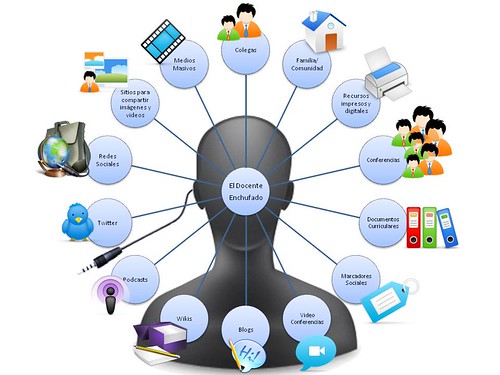 La clase de NTICx hoy comenzó con una pregunta de parte de nuestra
profesora, '¿De dónde creen ustedes, hoy en día, que se obtiene conocimiento o aprendizaje?' No sé qué pensaron mis compañeros, pero yo estaba perdida, por qué sin siquiera ponerme a pensar cada una de ellas, sabía que existen infinitas fuentes de conocimiento hoy en día a las que tenemos acceso. Creo igual que la profesora reconoció el pánico en nuestras caras y nos dio una idea: separar lo que teníamos en mente en Fuentes Análogas y Digitales.
Mi idea fue presentar mi trabajo en forma de red y medio desordenada, ya que así interpreto nuestro aprendizaje; como algo constante y continuo, que se conecta con distintos momentos de nuestras vidas y que cada uno entiende de distinta manera.

Una vez que todos terminamos compartimos lo que escribimos, y luego la profesora nos explicó el concepto de PLE (Personal Learning Environment). La sigla en español quiere decir 'Entornos Personales de Aprendizaje' (o 'Ambientes Personales de Aprendizaje') y se refiere a sistemas que ayudan a uno a gestionar y construir su conocimiento. Ya sea una aplicación de escritorio o una página web- hasta las relaciones interpersonales entre el que aprende y el que enseña, más el entorno en el que el primero convive. No es una aplicación o un programa, sino un enfoque, una manera de entender cómo se aprende. Te invito a ver el siguiente video, que es un poco largo pero explica bastante bien de lo que estoy hablando.
Así como nuestros cuadros, hay mucha gente que realiza unos parecidos, con el fin de explicar de una manera más sencilla y clara que son los Entornos Personales de Aprendizaje. Estos son unos ejemplos:


Fuentes:
http://www3.gobiernodecanarias.org/medusa/ecoescuela/blog/2011/06/30/entornos-personales-de-aprendizaje-ple/
http://www.humanodigital.com.ar/entornos-personales-de-aprendizaje-ple/#.VTgRbiEn_Gd
http://www.slideshare.net/qadmon/ambientes-personales-de-aprendizaje
http://reaprender.org/
Suscribirse a:
Entradas (Atom)